
One Quiet Season Just Repriced Three Years of Catastrophe Risk | Data ReFined #59

Data ReFined is dClimate's newsletter, delivering insights at the intersection of the voluntary carbon market (VCM), digital MRV technologies, climate risk management, and climate intelligence.
Catastrophe bonds, the securities that let insurers pass catastrophe risk, mostly US hurricane and earthquake, to investors, have just had their biggest nine months of issuance on record. Investors are also being paid less to carry that risk than at any point in five years. We think the second fact matters more, because these bonds run three to four years and their price was set by one quiet season.
Through September, sponsors issued $18.9 billion of cat bonds, past the record for the same period in 2025, and the outstanding market reached $65.5 billion, according to Artemis, the trade publication that tracks the market. That is the supply story, and every headline is running it.
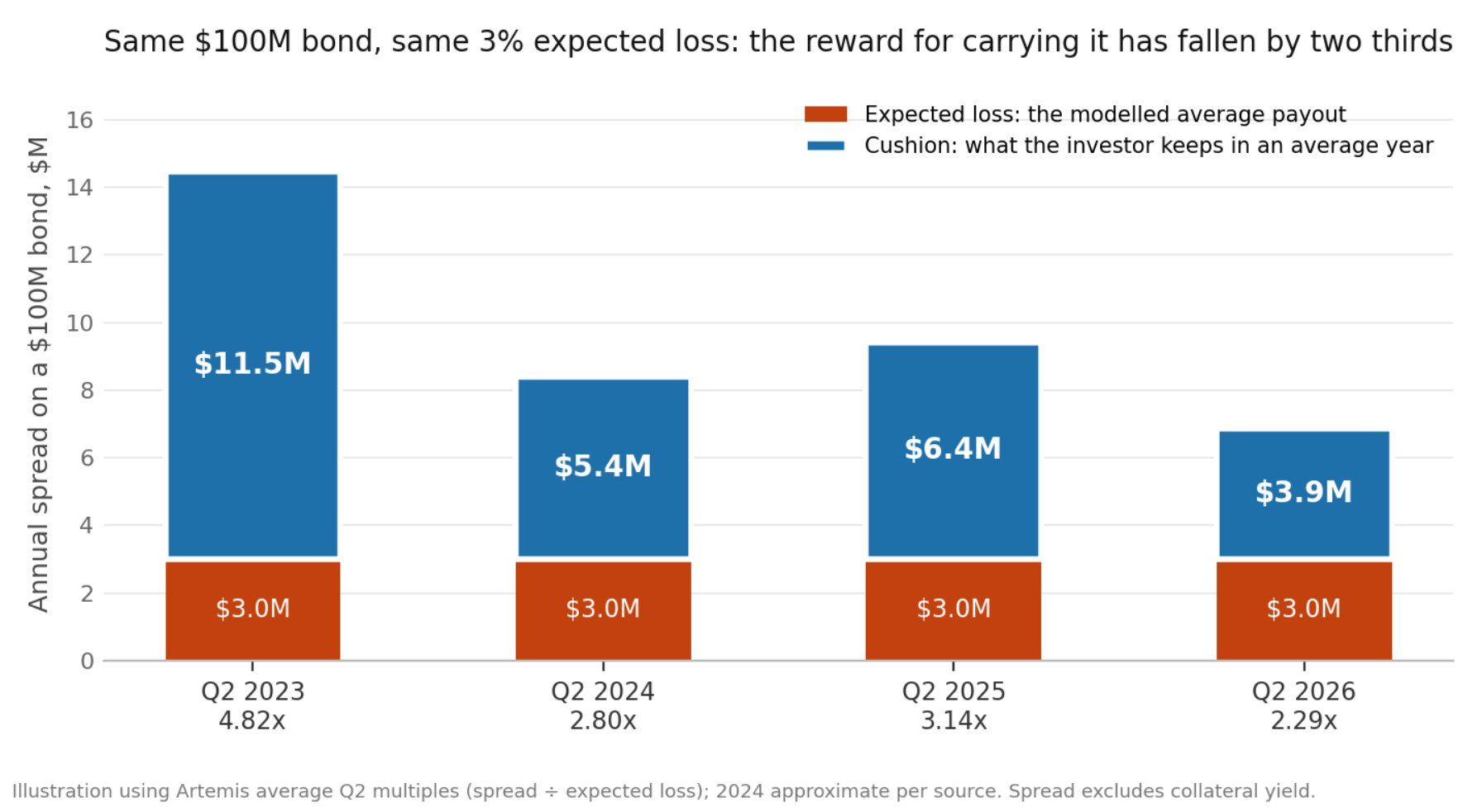
The price is best read through the multiple. A cat bond pays investors a spread, the coupon above the yield on the collateral. The bond also carries an expected loss, the payout the model expects in an average year. The multiple is the spread divided by the expected loss: how many dollars the investor is paid for every dollar the model expects them to lose. In an average year the investor pays out the expected loss and keeps the rest, and that remainder is the entire reward for taking the chance that the year is worse than average. In the second quarter the multiple fell to 2.29x, from 3.14x a year earlier and 4.82x in 2023. Sixty of seventy tranches priced below their initial guidance. On a $100 million bond, the reward looks like this.
What set that price is a quiet year. Swiss Re Institute puts first-half insured catastrophe losses at $42 billion, the lowest first half since 2020 and well under its $66 billion trend. Quiet is not the same as safe. Severe thunderstorm activity ran 20% above its ten-year average through June; losses were low because the worst storms missed Texas and the Southeast, not because the storms were fewer or weaker. Twelve Securis, an ILS fund manager, calls the strengthening El Niño a redistribution of risk rather than a reduction: the Atlantic goes quiet while typhoon, flood and wildfire exposure rise. A cheap Atlantic season explains cheap 2026 risk, but it does not explain cheap risk in 2027 through 2029, and that is what these bonds carry.
For a sponsor, this is the cheapest multi-year capacity in years; lock it in. For an investor, the reward for carrying the same modelled risk is a third of what it was in 2023, and the model is calibrated on years that include this one. We would not call it a bubble. Compression in a market growing this fast is what success looks like, and Icosa Investments' Dell'Amore said as much last week. The question is whether the risk takers pay for it, or the next loss year does.
The same reports hold a second number we find more interesting.
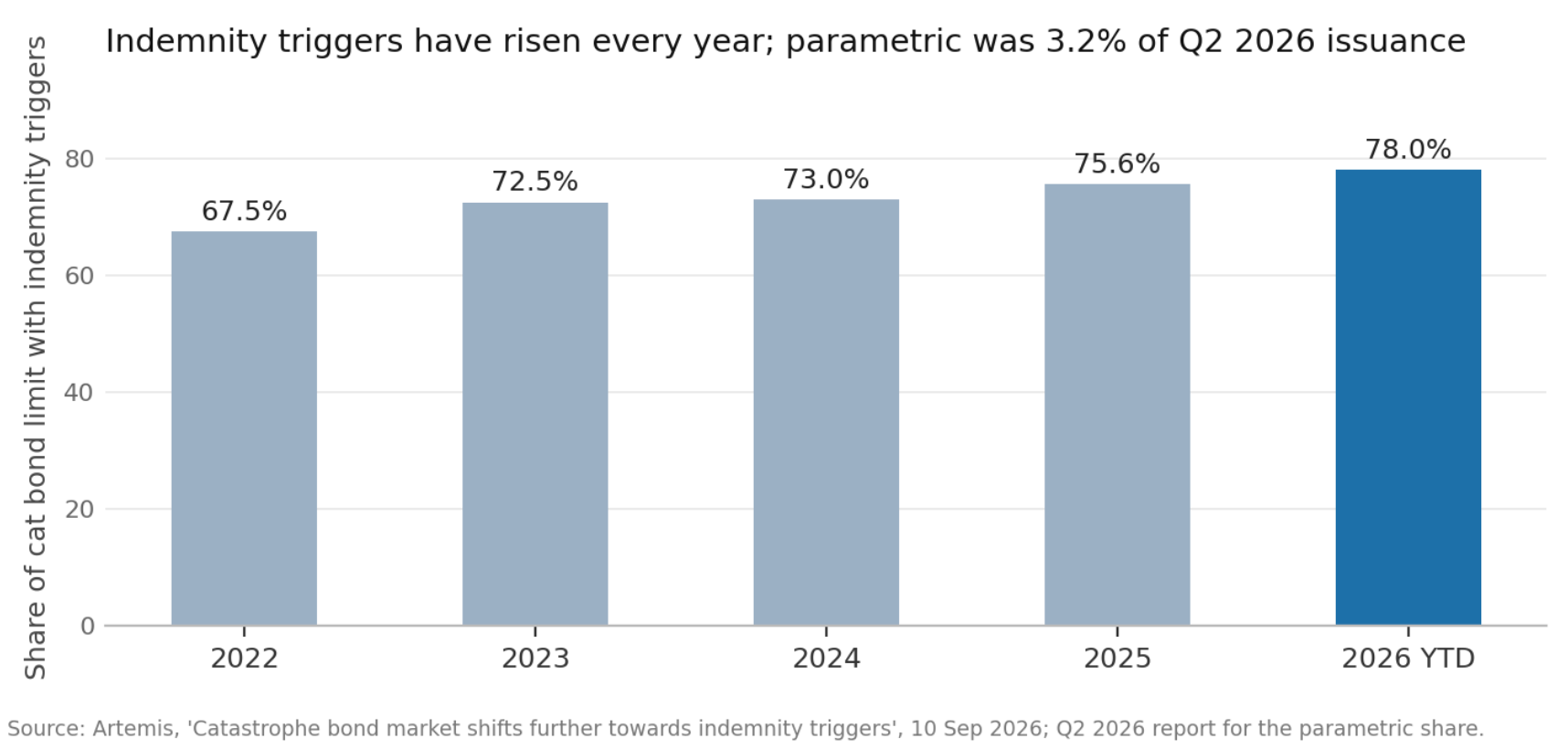
An indemnity trigger pays on the sponsor's actual claims; a parametric trigger pays on a measured event, such as wind speed at a named station. Indemnity is at a record 78% of limit issued this year. Parametric was 3.2% of second-quarter issuance. Artemis editor Steve Evans attributes the shift to sponsor preference, and we think that is the whole story, with one thing added: the sponsor's preference is strongest exactly when capital is cheap. Nobody can say for certain what investors prefer, but it is fair to assume they want to understand their exposure clearly, and parametric helps with that. The payout is settled days after the event rather than months after claims, the capital comes back quickly, and the investor carries no basis risk, the gap between what the index pays and what the insurer actually lost. The sponsor carries that gap, along with the accounting, audit and regulatory questions a parametric cover brings. So a sponsor accepts parametric when indemnity is expensive or unavailable, and drops it when the market will write indemnity at any price. A 2.29x multiple is that market, and the chart above and the one before it are the same fact seen twice.
Two things raise the parametric share from here. One is capital tightening, which takes away the sponsor's easy alternative. The other is data that shrinks the sponsor's basis risk enough to make the trade worth it: triggers built on data that resolves the insured properties themselves, at tens of metres, and modelled property by property with a tool like Aegis. That data now exists globally and for free, including the ten-metre embeddings released openly on AWS last month. Until one of those two things happens, we expect the parametric share to stay small while multiples sit near 2x.
What we are watching: the fourth quarter needs $1.1 billion to put 2026 over $20 billion for a second year, and January renewals will be negotiated against this quarter's prints. What would change our mind is a heavy loss year the market absorbs without the second-quarter multiple climbing back above 3x, or evidence that modelled expected losses on this year's deals were overstated.
Subscribe here and join over 4500+ readers!
Thank You For Reading Our Newsletter! 💙
We greatly appreciate your interest and support! If you enjoyed this newsletter, please consider forwarding it to your network to increase awareness of these critical climate topics.
About dClimate
dClimate’s decentralized and open climate data infrastructure powers a wide range of applications, including climate risk assessments, parametric insurance, and climate intelligence platforms for carbon and commodity markets.
⛅ Visit our website | 📊 Discover our products
Join the dClimate Community!
We welcome your comments, feedback, and likes. Follow us on the channels below to stay updated and start building in our decentralized climate data ecosystem. 👇
